NASCAR
Team Co-Owners Michael Jordan, Heather Gibbs Headline Fifth Day of NASCAR Antitrust Case
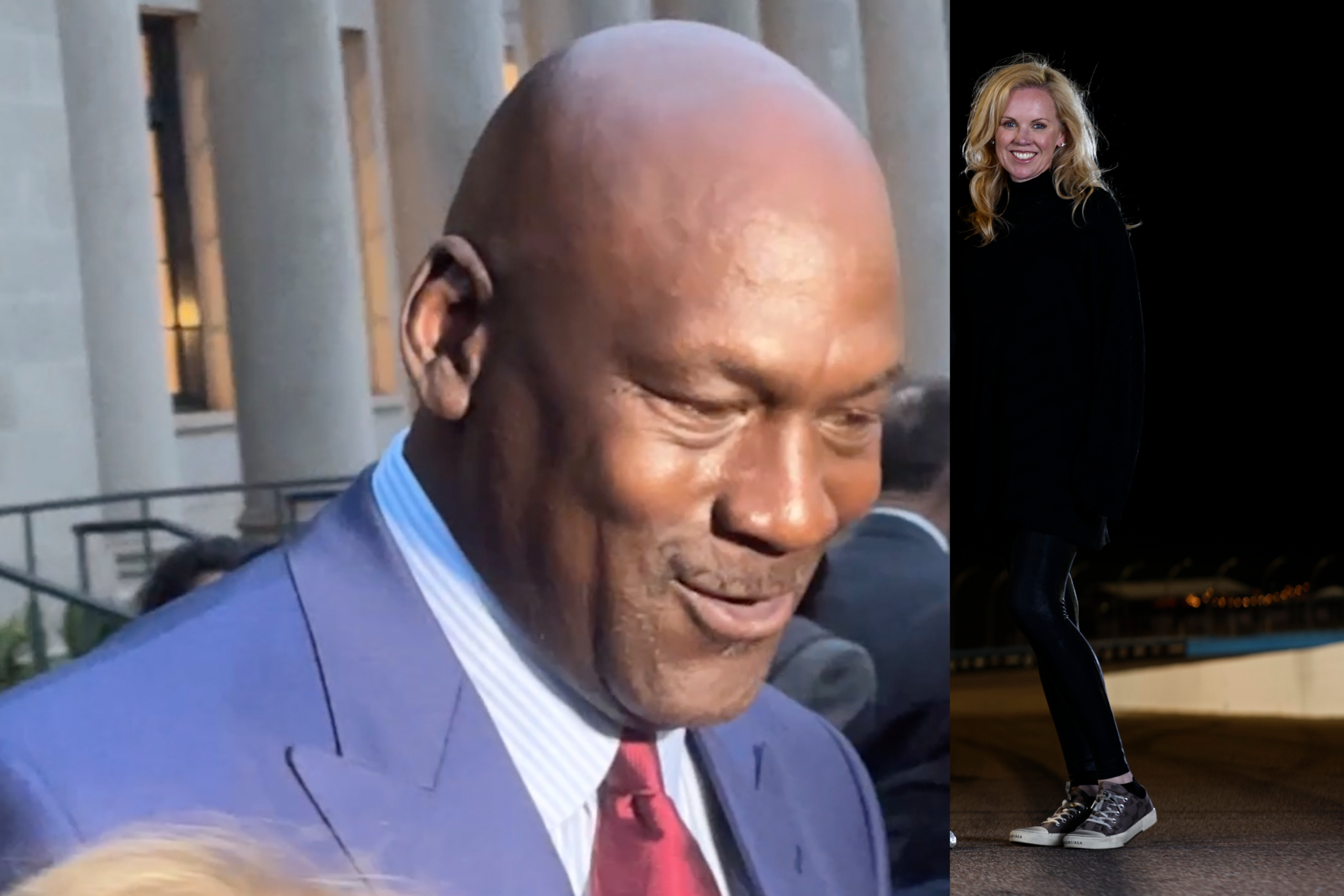
CHARLOTTE, N.C. – From North Carolina, at guard, 6’6″, Michael Jordan took to the NASCAR antitrust trial’s witness stand on Friday. Jordan, the basketball legend and 23XI Racing co-owner, said he “wasn’t afraid” to challenge the status quo of a seemingly broken financial system for NASCAR teams. Jordan was joined in testimony by Joe Gibbs Racing’s Heather Gibbs. Bookending them, however, were a wrap up of NASCAR President Steve O’Donnell’s examination, and Race Team Alliance Executive Director John Marshall.
“[The] NBA is a partnership with players and teams,” Jordan said during his hour-long testimony. “Here it’s different with a private entity and contracts. I wanted more of a partnership between both entities. If we both give up and compromise, there’s a chance to grow the business.”
Jordan detailed his background on following NASCAR from childhood, traveling with family to races at Rockingham, Charlotte, Darlington, and Talladega. His father was close friends with journeyman driver/owner and fellow Wilmington native Hoss Ellington. Jordan said he was initially a Richard Petty fan, just like his father. He did soon grow to: “admire Cale Yarborough, he was the original number 11, sorry Denny.” That last comment was one of many MJ one-liners leading to laughter across the courtroom.
Jordan then went in-depth on explaining why he chose to invest so heavily in forming 23XI Racing. This included buying three charters at ever-increasing prices. “Discussion with me and Denny on being successful NASCAR owners convinced me that a third driver improved our chances of winning and championships. I was vested in NASCAR and the opportunity presented itself.”
At the time of this writing, 23XI Racing’s brief five-year NASCAR Cup Series tenure has seen them purchase three charters. Their initial franchise came from the closing Germain Racing in 2020 for $4.7 million. Charter number two was bought in 2021 for $13.5 million after StarCom Racing shut down. 23XI’s most recent charter came from Stewart-Haas Racing for $28 million in 2024. Both Jordan and Denny Hamlin have explained why they chose to invest so heavily in a business model they now argue is broken for race teams.
“It felt like economics for every NASCAR team wasn’t being treated, someone had to step forward,” said Jordan. “Owners were browbeating for years and could not get change. I felt like I could challenge NASCAR as a whole. It needed to be looked at from a whole different perspective, that’s why we’re here.”
“For multiple reasons [the 2025 charter agreement] was not economically viable to us as an entity. It was not appropriate to say we couldn’t sue (a clause in the agreement), that ultimatum in negotiation did not suit 23XI.”
As laid out Monday by attorney Jeffrey Kessler, 23XI and Front Row are arguing in favor of four main pillars. They want permanent/evergreen charters, an increase in prize money payments, $20 million from NASCAR per car per year to cover operating costs, and a voice in the sport’s governance.
November 17, 2022 texts between Jordan and business partner Curtis Polk revealed that they were trying to meet with other teams and jointly raise these issues to NASCAR. “We were trying to educate teams on what was and was not fair based on economics. How it would benefit them to ask for a better deal to break even, or a better economic situation.”
“[We] understood from a balance sheet of partnership, we listened to what teams said. Create an environment for other teams to make stronger economic positions for teams and league.”
Jordan continued on the stand, saying “privately-owned equities such as NASCAR are rarely successful.”
More messages between Jordan and Polk from May 2024 referenced a meeting held between Polk and NASCAR Chairman Jim France. Polk said “Jim was nice, he never brought up the media stuff.” Polk also asked France if he had read a letter from some teams asking for evergreen charters. France had not read this request at that time, but Polk had, and said that “23XI would not support that.” This showed disagreement between some race teams, and Polk claimed he would send a followup letter with “alternative evergreen language.”
Jordan’s testimony was far from completely critical of the stock car racing sanctioning body. He praised recent NASCAR innovations like the Next Gen Car, the schedule, some new rules, and a competitive format as some significant changes. “I’m not discrediting what NASCAR’s done for the sport. I’m pushing them to make it better. What’s being missed here is credit. Not getting the same response with no insurance or union or benefits. The sport needs to continue to grow and unify between the teams and the France family. I never saw Jim France drive a car or risk his life. Give more credit to those who risk their lives everyday.”
“Revenue share should make sense for both parties. There’s a number that makes sense based on economics. We should build on that…until everyone is happy.”
23XI Racing’s business model relies on a technical partnership with Toyota powerhouse team Joe Gibbs Racing. It was revealed that 23XI pays Gibbs $5.8 million per year for data and racecars. JGR co-owner Heather Gibbs was called to the stand as a witness before Jordan, and gave her own very powerful and moving testimony. She described her path to becoming a Gibbs family member after moving to Charlotte in 1995, meeting Coy Gibbs on a blind date and marrying him not long after.
Heather also went in-depth on describing the highs and lows of her son Ty Gibbs winning the 2022 Xfinity Series championship, only for Coy to “not wake up” that night. “It was the most special night for out family. That quickly turned into the worst thing that we’ve been put through.” Ever since Coy’s death, Heather assumed his co-ownership role within JGR to guide the family-run company.
Heather did make the courtroom laugh when she said. “We have five [Cup championships], it should have been six” referencing Denny Hamlin in 2025. “Denny is our legacy driver.”
Gibbs then gave her perspective on the ‘take it or leave it’ charter agreement offer from September 6, 2024. She said their decision to ultimately sign the deal came down to “the legacy of Coy, JD, our family, and 450 employees. We wouldn’t have been able to keep going without it.”
Jim France told Heather Gibbs privately that “I’m done with this conversation…if I wake up with 20 or 30 charters, then so be it.”
Heather also explained that JGR was able to put in an amendment to the 2025 agreement, a document that had many grammatical errors including misspelled names. “It was like having a gun to your head.”
Joe Gibbs was left alone in his office that night, having not eaten all day and with a blood sugar monitor going off. Heather had to take one of her other children to a travel league baseball game in Chapel Hill. Joe simply told her “we can’t lose this.”
Heather told the court “It was not a fair deal to the teams, but we participate in the sport because we love it.”
Gibbs reiterated that permanent charters were seen as a safety net for all teams. Joe Gibbs Racing has no outside revenue sources, and is reliant on sponsors to turn any profits.
NASCAR President Steve O’Donnell, who finished his questioning Friday morning, gave NASCAR’s perspective against permanent charters. O’Donnell mentioned the uncertainty of future revenue streams, broadcast rights and racing schedules as a major drawback to permanent charters. “We need the ability to be flexible,” O’Donnell said.
Friday’s hearing ended with the cross-examination of John Marshall, Executive Director of the Race Team Alliance (RTA), a non-profit group of NASCAR Cup Series team owners.
Marshall compared franchise values in other sports with NASCAR teams. Under cross-examination, though, he said that the sanctioning body, a family-owned enterprise, differed from stick-and-ball franchises where the teams own their respective leagues and have much higher buy-in prices.
Marshall, whose cross-examination will continue Monday morning, did admit that the RTA trademarked the name “U.S. Racing League,” thus suggesting a NASCAR alternative racing series. Despite this trademark being filed, the RTA did not follow through with preliminary ideas of forming this rival competitive division.
Written by Peter Stratta
Be sure to follow us on Twitter/X
Be sure to follow the writer on Twitter/X
Photo Credits to Peter Stratta/TSJSports and Meg Oliphant/Getty Images